Current to September 25, 2026. Figures use Ontario rates.
The salary-versus-dividend decision is the most common planning question an Ontario owner-manager asks. For years, the answer at most income levels was “it barely matters”: Canada's integration system is designed so that income earned through a corporation and paid out as a dividend is taxed about the same as income paid directly as salary.
Two Ontario changes announced in the 2026 Ontario Budget shift that balance slightly, and they create a timing issue many practitioners haven't noticed yet.
What changed in Ontario
1. The small business rate fell on July 1, 2026
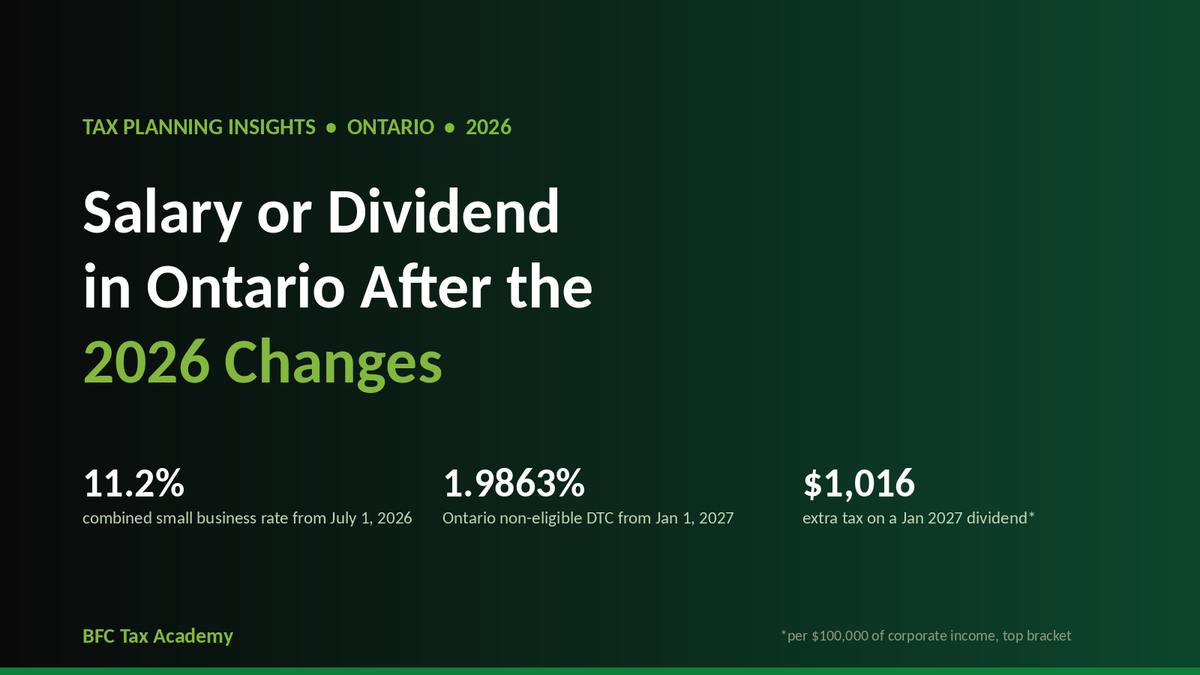
Ontario cut its small business corporate tax rate from 3.2% to 2.2% effective July 1, 2026. Combined with the 9% federal rate, active business income eligible for the small business deduction is now taxed at 11.2%, down from 12.2%.
Taxation years that straddle July 1 are prorated by days. For a corporation with a December 31 year-end, the 2026 Ontario rate works out to about 2.70%, for a combined rate of roughly 11.70%.
The $500,000 small business limit is unchanged. Some online sources claim Ontario raised its limit to $600,000; that came from a private member's bill that did not become law.
2. The non-eligible dividend tax credit falls on January 1, 2027
To keep integration in balance after the lower corporate rate, Ontario is reducing its dividend tax credit on non-eligible dividends from 2.9863% to 1.9863% of the grossed-up dividend, effective January 1, 2027.
At the top bracket, that raises the combined federal-Ontario rate on non-eligible dividends from 47.74% in 2026 to approximately 48.89% in 2027 (our projection, assuming 2027 top rates are otherwise unchanged).
What it means at the top bracket
Take an owner already earning over $300,000 who wants an extra $100,000 of pre-tax corporate income paid out, with a December 31 corporate year-end:
| Per $100,000 of corporate income | Bonus (salary) | Dividend, Dec 2026 | Dividend, Jan 2027 |
|---|---|---|---|
| Corporate tax | $0 | $11,700 | $11,700 |
| Paid to owner | $100,000 | $88,300 | $88,300 |
| Personal rate | 53.53% | 47.74% | 48.89% |
| After-tax cash | $46,470 | $46,146 | $45,130 |
Three takeaways:
- Salary now edges ahead at the top bracket. Using full-year 2027 figures, $100 of corporate income leaves about $46.47 as salary but only $45.39 as a non-eligible dividend, a gap of roughly 1.1% in favour of salary.
- The “pay the dividend in January” habit now costs money. Paying the same dividend in January 2027 instead of December 2026 costs about $1,016 on a $100,000 extraction.
- An accrued bonus keeps the deferral. A bonus declared by December 31, 2026 is deductible to the corporation in 2026 if it is paid within 179 days of year-end (by June 28, 2027 for a December year-end), and it is taxed personally when received. Support it with a directors' resolution dated on or before year-end.
What about lower brackets?
The same shift applies at every bracket, because the credit reduction is a flat percentage of the grossed-up dividend: roughly 1.15% of the dividend. In the $117,045–$150,000 bracket, for example, $10,000 of corporate income taxed at 11.2% leaves about $5,659 as salary, $5,674 as a dividend paid in 2026, and about $5,572 as a dividend paid in 2027. At that level the pure tax difference is small either way, and the decision should turn on the factors below.
The factors that often matter more than the rate
- RRSP room. Only salary creates RRSP room. Earned income of $196,611 in 2026 is needed to reach the maximum 2027 RRSP limit of $35,390.
- CPP. Salary of $85,000 or more costs $9,292.90 in total CPP for 2026 (both the owner's and the corporation's share), but it builds an indexed CPP pension that a dividend-only strategy never does.
- EI. Owners of more than 40% of the voting shares are generally not insurable, so no EI premiums apply to their salary.
- Individual pension plans. An IPP requires T4 employment income.
- The future sale. Cumulative net investment losses (CNIL) can limit a lifetime capital gains exemption claim in the year of a sale. Review the owner's CNIL history before settling on a long-term remuneration mix.
- Retained earnings. Leaving surplus income in the corporation still defers a large amount of tax (11.2% corporately versus up to 53.53% personally), but passive investment income over $50,000 a year starts reducing the federal small business limit.
The bottom line
For Ontario owner-managers at the top bracket, salary is now modestly better than non-eligible dividends from 2027 onward, and any non-eligible dividends planned for early 2027 are worth reconsidering before December 31, 2026. At lower brackets, integration is still close, so RRSP room, CPP, pension planning and the owner's sale plans should drive the mix.
This topic is worked through in full, with the prorated rate calculation, the bonus timing rules and reviewer commentary, in Case 1 of our workbook Owner-Manager Tax & Estate Planning in Canada (2026 Edition), alongside six more cases covering TOSI, the passive income grind, estate freezes, post-mortem planning and salary versus management fees.
This article is educational information for accounting and tax professionals, not tax advice. Rates and rules change; confirm current figures against the Income Tax Act, CRA and Ontario Ministry of Finance sources before advising clients.
Seven Canadian owner-manager case studies with fully worked solutions and 2026 figures.